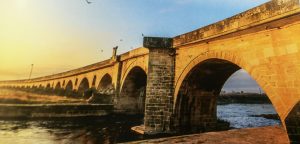
 We are a Youth Tour club from the English Language School in Burgas. One early morning we started our trip to the neighbouring country Turkey. Our aim was to visit the Edirne district and see the most interesting places on our way. Most of us expected to meet with the strange culture that comes from the sweetness of the ”baklava“ and the lemon scented eau de cologne, to the Mosques that appear in every settlement. We crossed the picturesque Strandzha Mountain and then we saw the rice fields of the Edirne district. Now we are very close to a comparatively small town named Uzunkopru. Its name comes after the long stone bridge through which we enter the town. The historical landmark actually gives the name of the town itself – in Turkish, Uzunköprü stands for Long Bridge. It is the longest stone bridge in the world that was built by the architect Muslihiddin, who was eminent for his time. The order for his ascension is to the Ottoman sultan Murad II. Man feels strange when seeing such a magnificent architecture facility. It shows monumentality and splendour. Entering the town it becomes obvious that people are occupied mainly in farming. Through the window of the bus we saw tractors, heavy tracks, and warehouses full of rice and other cereals. Life in such town seems to be calm and predictable. It was a surprise to us that we were accommodated in a small boutique hotel in which we stayed for a couple of days. We cannot but mention the hospitality of our Turkish friends. They met us at the school called “ Muzaffer Atasay”. Our arrival caused a great interest to the Turkish students who stayed at the windows and then went after us and greeted us in the corridors of the school. It was very surprising to us either. What impressed us most in the Turkish school was the inevitable combination of strict rules, followed by traditions and new technologies. We enjoyed the hospitality on behalf of the Principal. Our partners from the Turkish “Youth Club” showed Presentations about the sites that we were supposed to visit in Uzunkopru. Our expert guide narrated about the most interesting tourist places in Bulgaria. Then there started our tour around the town.
 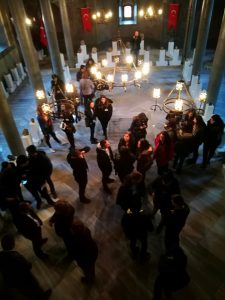 We visited a restored church “ St. John-the Baptist “ that had been turned into a museum. On the first floor there was a weird exhibition of stones showing the magic of mother Nature-heads of men and animals found by a shepherd. On the second floor there were exhibited 3D pictures with scenes from the Bible. This was really an interesting place to see because this church hasn’t been active since1930, and it was restored by the municipality of the town.We saw some other places of interest like the Muradiye mosque, the Monument of liberty, the castle of Altinyazi, but some were left for the next visit to the town.
On the following day we continued our trip to Edirne. The worldwide fame was brought to Edirne in 2011 when the Selimiye mosque was inscribed to the UNESCO World Heritage List and the fact that Edirne used to be the Ottoman capital, not many tourists realise that it is possible to visit the remains of the palace built by the Ottoman sultans there.
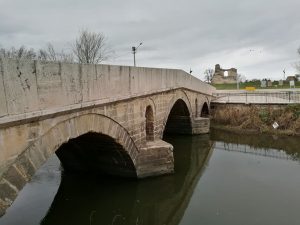 Our visit started from the Ottoman palace in Edirne–Saray-ı Cedid-i Amire. Saray-ı Cedid-i Amire palace is situated in the northern part of Edirne. It is possible to go there from the center of the city, starting from Selimiye Mosque. The construction of the palace in Edirne started in 1450 by the order of Sultan Murad II. The hunting grounds on the west bank of the Tundzha River were selected as its location. It was further from the centre of Edirne than the Old Palace (Saray-i Atik) that had stood in the spot where Selimiye Mosque was later erected. The palace was called Saray-ı Cedid-i Amire (i.e. New Imperial Palace), and it was systematically expanded. The decoration and enlargement of the palace were due to the engagement of the successive sultans, including Suleiman the Magnificent and Mehmet the IV. The Justice Kasri Tower is before the palace. Built by Great architect Sinan at the request of Sultan Suleiman, the Magnificent in 1562 it reflects the Seljuk Architecture Style. That dreamy khedive ( the ruler exercising authority in a colony on behalf of a sovereign) made of stone was used as a meeting location for Divan-I Humayun (Council of Ministers) and High Court. Also there is found a fountain next to it in order to prevent from hearing the important speakings in that place. Next to the palace one can visit
 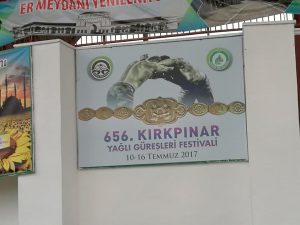 Kırkpınar oil wrestling festival Inscribed in 2010 on the Representative List of the Intangible Cultural Heritage of Humanity. The Kırkpınar oil wrestling festival takes place in Edirne, Turkey once each year in June. Thousands of people from different age groups, cultures and regions travel every year to see ”Pehlivan” (wrestlers) fight for the Kırkpınar Golden Belt and the title of Chief Pehlivan.
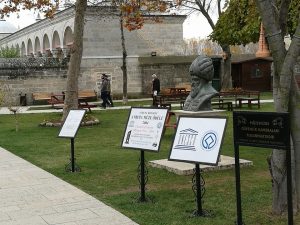 Our next stop is at the Health museum. in Edirne. Health Museum (tr. Sağlık Müzesi) is a unique venue, situated in the area of Sultan Bayezid II Mosque Complex in Edirne. It houses recreated rooms of a hospital from the Ottoman period. The museum is the second most visited historical site in Edirne, after the Selimiye Mosque. The hospital was called Darüşşifa in old Turkish, from the Arabic word Dar al-Shifa. It was opened at the time of Sultan Bayezid II period in 1488. It had treated patients for over 400 years, until 1909. Just next to the hospital, there was a medical school that trained doctors for the Ottoman Empire, until the end of the 19th century. The hospital and the school formed one of the most important medical centres of the Middle East. The Ottoman medicine was founded on the tradition of Turkish-Islamic medicine. The ideas expressed by Avicenna and Al-Farabi were implemented in the Ottoman hospital in Edirne. Among with the conventional methods employed, we should mention the therapy with the sound of water, music therapy, aromatherapy, and handcraft therapy. Patients suffering from neurological and psychiatric disorders were treated with these therapies in Edirne, when in Western Europe there were cases of burning the people with mental problems at stake from the practitioners of black magic. Notably, the hall is an architectural masterpiece with excellent acoustics. The medical school was next to the hospital. It was an elite university that taught innovative approaches to surgery and the treatment of mentally ill people. Its students could apply their knowledge while practising at the local hospital. This museum, the only one of its kind in Turkey, has received many national and international awards, including the European Museum of the Year, awarded in 2004 by the Council of Europe.
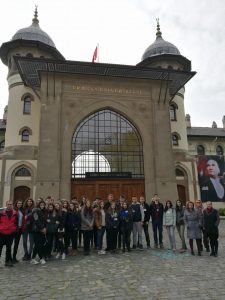 The next venue to visit was Trakya University Lausanne Monument, the Square and the Museum. Karaagach was given to Turkey as a war indemnity with Lausanne Peace Treaty which is the identity card of the Republic of Turkey. Karaagach is situated in the Anıt-Kent, Edirne, 10 km away from the center, near the Maritsa river, in the willow forest where mansions and residences with large gardens show the architectural characteristics of the period. The Maritsa River is the border between Greece and Turkey except in one place,
 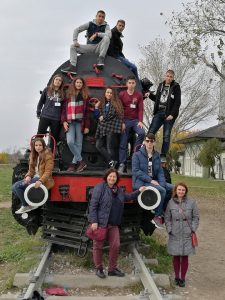 the old station of Edirne in the picturesque neighborhood Karaagach. It is the only territory of Turkey west of the Maritsa river and a place man should not miss when we go to Edirne. This building which is in Karaagach district in Edirne was also used as a train station until 1972. After that, it was assigned to Trakya University, embodied many units of it and was used as social facility. The station building is one example of railway architecture in the late XIXth century. Inaugurated monument being ferroconcrete consists of columns which were implanted on 3 cantilevers that are stuck to the base slab with 45 degree angle and independent of each other. The figure of a young woman which is placed at 4.20 m high of the front face of this circle stands for aesthetics, elegancy and law. The pigeon in one of the hands of the young woman represents peace and democracy and the document in her other hand represents
 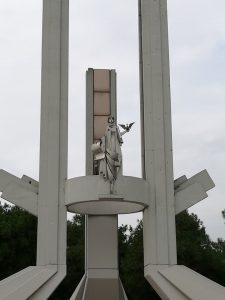 Lausanne Peace Treaty. The 15 m radius semi-circle-shaped pool placed at the feet of the monument symbolizes the seas which encircle Turkey.
The other sites that we went through, were religious. In Edirne all the religions were respected. Of course, there were several mosques, but a synagogue and an Orthodox church were available as well. St. Georgi Bulgarian Orthodox Church is located in the Kıyık District, Barutluk Neighborhood, Tavukçu Street of Edirne. The church was built in the XIX century and worship service started in Sveti Georgi by July 24, 1880 The church is quite rich in terms of the icons present. Within the building, icons of Jesus, Virgin Mary, John the Baptist and other saints are in good condition. Apart from those certain prayer icons, didactic ones and icons representing the Holy Trinity can be seen in the Sveti Georgi Church… On our way to the Synagogue we passed through the Selimiye Arasta (Covered Bazaar) that was built to provide income to Selimiye Mosque during the time of Sultan Murat III. Nowadays, a majority of the shops in the arasta sell touristic goods and it is an important shopping spot for the tourists who come to visit the Selimiye Mosque. While walking along the streets of the old district of Edirne, it is easy to reach Maarif Street. There, at its southern end stands the newly restored building of the Grand Synagogue of Edirne (tr. Edirne Büyük Sinagogu). The fate of this building reflects the turbulent history of the Jewish community of Edirne, once very numerous, and now almost non-existent. The new synagogue was modelled by the famous Leopoldstädter Tempel – the largest synagogue of Vienna – as it was designated to demonstrate the community’s achievements and modernity. Grand Synagogue of Edirne was designed by the French architect France Depré in the architectural style of Moorish Revival. We were astonished by the beautiful building of the synagogue.
The Selimiye Mosque,the next venue that we visited, was constructed between 1566 and 1574, on the orders of Sultan Selim II, also known as “Selim the Drunkard”.
Selimiye Mosque is the most important and, at the same time, the most famous historical monument of Edirne. This Ottoman imperial mosque was designed by Mimar Sinan, the most distinguished architect of the Ottoman Empire, responsible for the erection of more than 300 buildings, including bridges, medreses, and mosques.
Selimiye Mosque is considered to be Sinan’s finest piece of work and the culmination of Islamic architecture in the Ottoman Empire. It was planned as a part of the entire architectural complex, known as külliye, consisting of the mosque, two medreses (theological schools), a covered bazaar called Selimiye Arastası, a clock tower, numerous courtyards and a library. The whole complex was inscribed in 2011 on the UNESCO World Heritage List, in recognition of architectural values and harmonious connection of its elements.
We visited and saw all these places and still feel the taste of “tolumba” and the smell of fish, sweet cotton, “pishmanie”, and many other interesting foods typical for Turkey that tradesmen presented to us on the main Edirne street. It was overcrowded but pleasant. You can bargain for every commodity you buy and you will get a discount. There was not much time to wander around the picturesque streets of this colourful town. We liked it so much that we promised to our Turkish friends that we should come again.
Our next day’s activities started with a ceremony in the center of Uzuncopru. It was the 18th of November- the Independence day. It was the year of 1922 when the Greek troops left the town.
After the ceremony we started for Enez, a small town situated on the Aegean sea. On our way we passed through Ipsala that lies just east of the main border crossing, bearing the same name with the town, between Turkey and Greece. Most travellers will just pass through while transiting between these two countries. The main livelihood is rice cultivation; the flatlands surrounding the town, irrigated copiously by the Merich River, produce about half of Turkey’s total rice output alone. From Ipsala to Enes there are only 21km.
Enez is a town in Edirne Province, in Thrace, Turkey. The town is located on the left (eastern) bank of the Maritsa river , where its estuary broadens to flow into the Gulf of Saros, the ancient Melas Gulf, and so into the Aegean Sea. Enez occupies a ridge of rock surrounded by broad marshes. In ancient Greek times, it layed on a land route for trade from the Black Sea to the Aegean and was a port for the corn, wood and fruit produced in eastern and central Thrace.
Keshan is a city in Eastern Thrace, NW of Turkey. Keşan county is 60 km east, and the Aegean Sea and Greece are in the south and west, surrounded by a territorial and national border, with a total of 30 km of sea and 44 km of maritime boundaries.
It’s located on a junction on which roads from four major directions intersect (west from Greece, east from Istanbul, south from Channackkale( Aegean Coast), and north from Edirne. But it was dark in the evening and we just passed. For this day it was enough.
Full of emotions and impressions and, of course, lots of bags with presents from Edirne province, on the next day we started for our native town Burgas. It was a wonderful trip: we made a lot of friends and enriched ourselves with interesting knowledge about the culture of Turkey and the Edirne area. What we learned is the fact that the Turkish people are open-minded, friendly and hospitable. It was a nice and colourful trip, indeed!