 Bourgas region is a crossroad of ancient civilizations since the end of VII – V century BC. In the museums many artifacts are stored – stone, flint and bone tools, pottery and idol sculptures from the Neolithic and Copper Age. They were found in so-called “mounds” – over 100 in number, formed as a result of millennial life of small villages located near water source. In the Bourgas Bay were found buried villages from the Bronze Age (III century BC). Many stone anchors of different sizes talk about development of shipping in the Bay even at this early age. Evidence of trade contacts with the Thracians in the Mediterranean world in XV – XIII century BC is the copper ingot of Minoan type, found near Cherkovo, Bourgas region.
In Strandja Hills, rich of copper ores, live the Thracian tribes “Skirmiani” and “Tini”. They create the oldest metallurgical centers in our country.
Natural resources and favorable geographical position of Bourgas coastal areas attract Greek settlers, who at the end of VII century BC create Black sea trade colonies, the most known of which are Apollonia Pontica (Sozopol) and Messambria (Nessebar). In Apollonia, that reached its economic and cultural boom in the V century BC, was built the famous temple of Apollo. Here was placed a statue – a bronze colossus of Apollo, made by the ancient sculptor Kalamis. There is another statue of Apollo from the Archaic Age, found in the ancient village Antius, near by the today’s naval base Atia. From the ancient village, called “sweet wells”, localized in today’s Bourgas district “Pobeda” come one of the most beautiful red-vessels found in the Bulgarian lands.
The ancient city Deultum, located 18 km. south of Bourgas, was founded in the Roman Age. It was created in ’69 by Roman soldiers – veterans from VIII Augustin legion, who at the end of military service asked to be rewarded with “green land”. The strengthening of city’s borders with small fortresses, called “burgi” (drill) is related with the foundation of a village in the III – IV century, from which originates the name of Bourgas. One of the towers of this town is still presented in the “Poda” area, to the edema of the Mandra Lake in the Black sea.
Christianity has penetrated the Bourgas lands at the end of I-II century. Here, till the XV century were five Episcopal centers – Nessebar, Anhialo, Debelt, Sozopol and Ahtopol.
After the foundation of the First Bulgarian Empire in 681, her second ruler Khan Tervel in 708-716 joined the majority of Southern Black sea coast in the territory of Bulgaria. At that time began the construction of the large boundary ditch “Erkesiya” between Bulgaria and Byzantium, the beginning of which starts from the medieval town Debelt.
The history does not end here. But it is a clear evidence of the comfort and favorable conditions of the region in times without modern amenities and facilities.
Today Bourgas is one of the leading in economic development cities in Bulgaria, and setting industry for its prosperity is tourism!
Statistics and inform strategic documents:
– Bourgas region is located in the southeastern part of Bulgaria on a territory of 7748.067 square kilometers (6.9% of the area of Bulgaria) and is the second biggest region after Sofia region. To the east there is a wide area of Black sea bordering the region /224 km. /, to the south it is bordered by Turkey, to the west – by Yambol region and Sliven region, and to the north – by Varna region and Shumen region. In the region is situated the largest bay on the Black sea – Bourgas Bay with a width of 10-12.5 km. and a depth of 10-12 km. Near the beach are located the firth lakes – Burgas lake, Mandra lake and Atanasovsko lake, the latter being converted into a dam.
The outlet area of the Black sea increases the transport and geographical importance of the region. The eastern border is a prerequisite for the development of port work, fishing, tourism, foreign trade, concentration of production facilities and industries that rely on imported raw materials.
The geostrategic position of the region is a factor of national importance, which is acknowledged by several countries in Europe, Asia and Africa. Here traditional and new-built axes of economic and political interests are crossed as follows: Europe – Middle East – Asia, Europe – Middle East – Asia, Russia, Ukraine, Belarus and Western Europe.
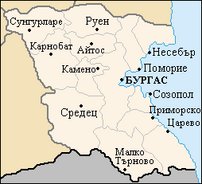
13 municipalities are situated in the region: Aytos, Bourgas, Kameno, Karnobat, Malko Tarnovo, Nessebar, Pomorie, Rouen, Sozopol, Sredetz, Sungurlare, Primorsko and Tsarevo.
Situated in the picturesque southern Bulgarian Black Sea coast, Bourgas region includes eastern Balkan, Strandja and Bourgas plain. There is a unique variety of nature, history and folklore. The region features beautiful beaches, easily accessible mountains with unique flora and fauna, unique historical monuments, traditions and customs.